
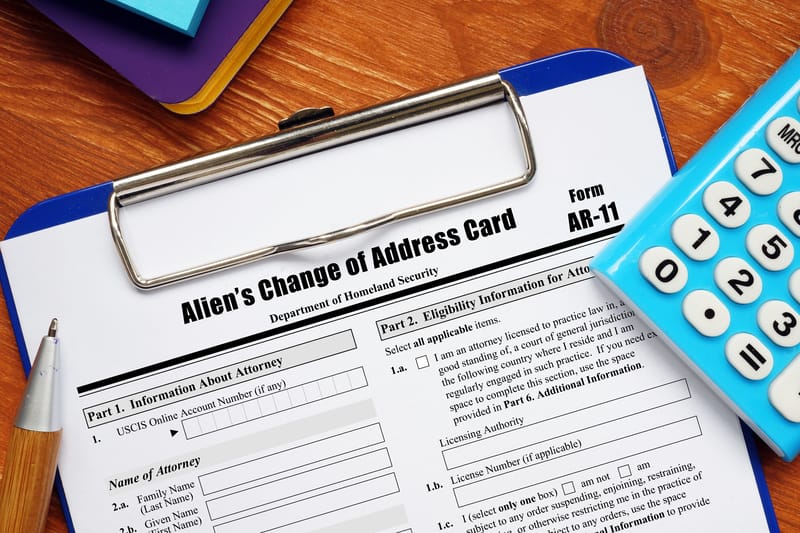
For decades, filing a change of address with U.S. Citizenship and Immigration Services (USCIS) was a routine, one-minute task. If you moved, you filed out a paper Form AR-11, mailed it in, and that was that. The problem was that you never knew whether USCIS would update your address, but USCIS eventually improved it by moving the form online. Once filed, you would receive instant notification that they received your change of address and it was linked to pending applications. Unfortunately, the Department of Homeland Security (“DHS”) now wishes to change the form. The details appeared in a federal notice published on May 7, 2026. They reveal a massive dark shift in how the government intends to use this simple form. DHS entitles this new form a “reinstatement with change” of the Alien Change of Address collection. Behind that bureaucratic language lies a significant new enforcement strategy: the government wants to turn your address update into a deep dive into your financial and work life. Furthermore, they wish to use it for deportation enforcement.
What is Changing?
If finalized, non-citizens required to report an address change must now disclose: (1) Public Benefits: You must report any receipt of “means-tested” benefits. (2) Work and School: You must provide details about your current job and education.
The Goal: Deportation Enforcement
This isn’t just about record-keeping. The notice explicitly states that this information will be used by the Secretary to enforce immigration laws. Specifically, the government wishes to enforce the public charge ground of deportation under INA section 237(a)(5).
By collecting this data every time an immigrant moves, USCIS aims to:
- Identify individuals who may be deportable under public charge grounds.
- Coordinate with benefit-granting agencies to identify people receiving assistance in violation of the 1996 Welfare Reform Act (PRWORA).
- Monitor the “public charge” status of non-citizens on an ongoing basis, rather than just during the initial Green Card or Visa application phase.
Why is this new form problematic?
There are several problems with collecting this information on a change-of-address form.
- USCIS already knows where people live and work. This information is already collected by USCIS when people apply for any immigration benefit. It is redundant to ask for this information again.
- Some immigrants are eligible for public benefits, and this form will cause confusion. Some immigrants, such as refugees or asylees, may receive certain public benefits. They will become confused and perhaps afraid to fill out this form. It will require them to call USCIS to clarify how to complete the form. They will not receive a clear answer from USCIS. As a result, many people will not fill out this form. Or, they may decide not to collect the benefits to which they are entitled.
- It will create confusion at USCIS. There are government benefits that people receive without making them a public charge. For instance, as I discussed in my blog post last week, the receipt of SSDI does not make someone a public charge. Because this new form asks for ‘means-tested’ benefits, many clients will naturally assume that includes their earned SSDI benefits, leading to unnecessary fear and potentially incorrect reporting that triggers a manual review by a USCIS officer who may not know the difference either.
- Immigrants cannot access public benefits. I do not know who the government is trying to catch with this form, but immigrants are not eligible to collect public benefits, with a few exceptions. Moreover, a person’s immigration status is verified when they apply for benefits. If they are not eligible, they cannot receive them. This form is not going to catch anyone.
- It is a waste of time and money. The government estimates that it currently takes 0.5 hours to complete the change-of-address form online. They expect this new form to take 0.47 hours. The government’s own estimate of a 1.2 million-hour annual burden is a massive waste of resources, given that the information is already in existing case files. The government admits this change will cost the public nearly $1 million annually in compliance costs, a heavy price for a form that provides no new useful data.
What Happens Next?
This is a 60-day notice, and the public is invited to submit comments until July 6, 2026. I encourage you to share your concerns about the “burden” and “privacy impact” of these changes. The law has not changed yet, so, of course, if you move, you may still use the current change-of-address form available in your USCIS online account.

